
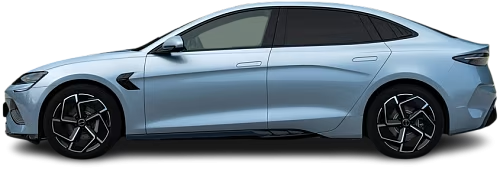
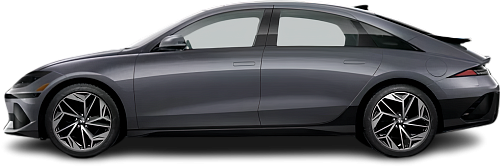
Global EV Comparison: BYD Seal Comfort RWD vs Hyundai Ioniq 6 Standard Range RWD
Struggling to Decide? Let AI Help!
Your AI Summary Is Ready!
General Info
Both vehicles are currently in production and can be purchased new. The BYD Seal Comfort RWD (2025-…) has a starting price of €41690, compared to the Hyundai Ioniq 6 Standard Range RWD (2023-…), which starts at €43900.
The two vehicles share the same body style: Sedan.
| Property | BYD Seal Comfort RWD | Hyundai Ioniq 6 Standard Range RWD |
|---|---|---|
| Years of Production | 2025-… | 2023-… |
| Current Status | Produced | Produced |
| Country of Manufacture | China | South Korea |
| Body Style | Sedan | Sedan |
| Market Availability | EU | EU, USA |
| Price Europe (New) | €41690 | €43900 |
| Price Europe (Used) | - Price Europe (Used) | €29990 |
| GCC Score | 6.1 | 6.3 |
Range and Efficiency
While the BYD Seal Comfort RWD (2025-…) offers a longer real-world range and a bigger battery, it is less energy-efficient than the Hyundai Ioniq 6 Standard Range RWD (2023-…).
| Property | BYD Seal Comfort RWD | Hyundai Ioniq 6 Standard Range RWD |
|---|---|---|
| Range (EPA) | - Range (EPA) | 386 km |
| Range (WLTP) | 460 km | 429 km |
| Range (GCC) | 391 km | 366 km |
| Battery Capacity (Nominal) | 63 kWh | 58 kWh |
| Battery Capacity (Usable) | 61.4 kWh | 54 kWh |
| Efficiency per 100 km | 15.7 kWh/100 km | 14.8 kWh/100 km |
| Efficiency per kWh | 6.37 km/kWh | 6.78 km/kWh |
| Range and Efficiency Score | 7.4 | 7.3 |
Charging
The Hyundai Ioniq 6 Standard Range RWD (2023-…) features an advanced 800-volt architecture, whereas the BYD Seal Comfort RWD (2025-…) relies on a standard 400-volt system.
The Hyundai Ioniq 6 Standard Range RWD (2023-…) offers faster charging speeds at DC stations, reaching up to 175 kW, while the BYD Seal Comfort RWD (2025-…) maxes out at 110 kW.
Both vehicles are equipped with the same on-board charger, supporting a maximum AC charging power of 11 kW.
| Property | BYD Seal Comfort RWD | Hyundai Ioniq 6 Standard Range RWD |
|---|---|---|
| Max Charging Power (AC) | 11 kW | 11 kW |
| Max Charging Power (DC) | 110 kW | 175 kW |
| Architecture | 400 V | 800 V |
| Charge Port | CCS Type 2 | CCS Type 2 |
| Charging Score | 5.6 | 7 |
Performance
Both vehicles are rear-wheel drive.
The BYD Seal Comfort RWD (2025-…) boasts greater motor power and accelerates faster from 0 to 100 km/h.
| Property | BYD Seal Comfort RWD | Hyundai Ioniq 6 Standard Range RWD |
|---|---|---|
| Drive Type | RWD | RWD |
| Motor Type | PMSM | PMSM |
| Motor Power (kW) | 170 kW | 111 kW |
| Motor Power (hp) | 228 hp | 149 hp |
| Motor Torque | 380 Nm | 350 Nm |
| 0-100 km/h | 7.5 s | 8.8 s |
| Top Speed | 220 km/h | 185 km/h |
| Performance Score | 4.5 | 3.6 |
Dimensions
The Hyundai Ioniq 6 Standard Range RWD (2023-…) is taller, but has a similar length and width to the BYD Seal Comfort RWD (2025-…).
Both models have similar wheelbase lengths.
| Property | BYD Seal Comfort RWD | Hyundai Ioniq 6 Standard Range RWD |
|---|---|---|
| Length | 4800 mm | 4855 mm |
| Width (with Mirrors) | 2150 mm | 2073 mm |
| Width (w/o Mirrors) | 1875 mm | 1880 mm |
| Height | 1460 mm | 1495 mm |
| Wheelbase | 2920 mm | 2950 mm |
Cargo and Towing
Both models feature a convenient frunk (front trunk), providing additional storage space.
When it comes to towing, both cars offer identical towing capacity (up to 750 kg).
| Property | BYD Seal Comfort RWD | Hyundai Ioniq 6 Standard Range RWD |
|---|---|---|
| Number of Seats | 5 | 5 |
| Curb Weight | 1982 kg | 1850 kg |
| Cargo Volume (Trunk) | 400 l | 401 l |
| Cargo Volume (Frunk) | 53 l | 45 l |
| Towing Capacity | 750 kg | 750 kg |
| Cargo and Towing Score | 5.3 | 5.5 |