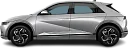
Global EV Comparison: Hyundai Ioniq 5 Standard Range AWD vs Mercedes EQB 300 4MATIC
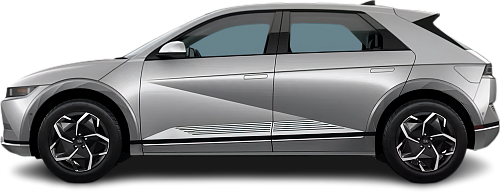
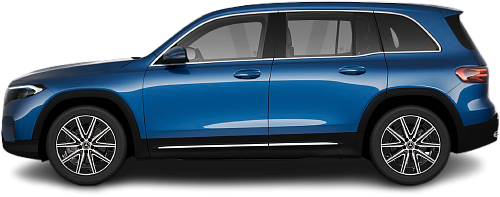
Struggling to Decide? Let AI Help!
Your AI Summary Is Ready!
General Info
Since both vehicles have been discontinued, they are now only available on the used car market. You can get the Hyundai Ioniq 5 Standard Range AWD (2021-2022) for as low as €33900, while the Mercedes EQB 300 4MATIC (2022-2023) begins at €32950.
The two vehicles share the same body style: SUV.
| Property | Hyundai Ioniq 5 Standard Range AWD | Mercedes EQB 300 4MATIC |
|---|---|---|
| Years of Production | 2021-2022 | 2022-2023 |
| Current Status | Discontinued | Discontinued |
| Country of Manufacture | Indonesia, Singapore, South Korea | Hungary |
| Body Style | SUV | SUV |
| Market Availability | EU | EU, USA |
| Price Europe (Used) | €33900 | €32950 |
| GCC Score | 6.4 | 6 |
Range and Efficiency
While the Mercedes EQB 300 4MATIC (2022-2023) offers a longer real-world range and a bigger battery, it is less energy-efficient than the Hyundai Ioniq 5 Standard Range AWD (2021-2022).
| Property | Hyundai Ioniq 5 Standard Range AWD | Mercedes EQB 300 4MATIC |
|---|---|---|
| Range (EPA) | - Range (EPA) | 391 km |
| Range (WLTP) | 362 km | 423 km |
| Range (GCC) | 308 km | 362 km |
| Battery Capacity (Nominal) | 58 kWh | 69.7 kWh |
| Battery Capacity (Usable) | 54 kWh | 66.5 kWh |
| Efficiency per 100 km | 17.5 kWh/100 km | 18.4 kWh/100 km |
| Efficiency per kWh | 5.7 km/kWh | 5.44 km/kWh |
| Range and Efficiency Score | 5.8 | 6.1 |
Charging
The Hyundai Ioniq 5 Standard Range AWD (2021-2022) features an advanced 800-volt architecture, whereas the Mercedes EQB 300 4MATIC (2022-2023) relies on a standard 400-volt system.
The Hyundai Ioniq 5 Standard Range AWD (2021-2022) offers faster charging speeds at DC stations, reaching up to 175 kW, while the Mercedes EQB 300 4MATIC (2022-2023) maxes out at 100 kW.
Both vehicles are equipped with the same on-board charger, supporting a maximum AC charging power of 11 kW.
| Property | Hyundai Ioniq 5 Standard Range AWD | Mercedes EQB 300 4MATIC |
|---|---|---|
| Max Charging Power (AC) | 11 kW | 11 kW |
| Max Charging Power (DC) | 175 kW | 100 kW |
| Architecture | 800 V | 400 V |
| Charge Port | CCS Type 2 | CCS Type 2 |
| Charging Score | 6.9 | 5.4 |
Performance
Both vehicles are all-wheel drive.
The Hyundai Ioniq 5 Standard Range AWD (2021-2022) boasts greater motor power and accelerates faster from 0 to 100 km/h.
| Property | Hyundai Ioniq 5 Standard Range AWD | Mercedes EQB 300 4MATIC |
|---|---|---|
| Drive Type | AWD | AWD |
| Motor Type | PMSM (front), PMSM (rear) | IM (front), PMSM (rear) |
| Motor Power (kW) | 173 kW | 168 kW |
| Motor Power (hp) | 232 hp | 225 hp |
| Motor Torque | 605 Nm | 390 Nm |
| 0-100 km/h | 6.1 s | 8 s |
| Top Speed | 185 km/h | 160 km/h |
| Performance Score | 4.8 | 3.7 |
Dimensions
The Hyundai Ioniq 5 Standard Range AWD (2021-2022) has a wider body, offering a more shoulder room, while the Mercedes EQB 300 4MATIC (2022-2023) stands taller for a more elevated driving position. Despite these differences, their lengths are nearly identical.
The Hyundai Ioniq 5 Standard Range AWD (2021-2022) boasts a more extended wheelbase.
| Property | Hyundai Ioniq 5 Standard Range AWD | Mercedes EQB 300 4MATIC |
|---|---|---|
| Length | 4635 mm | 4684 mm |
| Width (with Mirrors) | 2152 mm | 2020 mm |
| Width (w/o Mirrors) | 1890 mm | 1834 mm |
| Height | 1605 mm | 1667 mm |
| Wheelbase | 3000 mm | 2829 mm |
Cargo and Towing
The Hyundai Ioniq 5 Standard Range AWD (2021-2022) features a larger trunk, but the Mercedes EQB 300 4MATIC (2022-2023) offers greater maximum cargo capacity when the rear seats are folded.
A frunk (front trunk) is available in the Hyundai Ioniq 5 Standard Range AWD (2021-2022), but the Mercedes EQB 300 4MATIC (2022-2023) doesn’t have one.
Neither vehicle is officially rated for towing in in the EU.
| Property | Hyundai Ioniq 5 Standard Range AWD | Mercedes EQB 300 4MATIC |
|---|---|---|
| Number of Seats | 5 | 5, 7 |
| Curb Weight | 2015 kg | 2175 kg |
| Cargo Volume (Trunk) | 531 l | 495 l |
| Cargo Volume (Max) | 1591 l | 1710 l |
| Cargo Volume (Frunk) | 24 l | - Cargo Volume (Frunk) |
| Towing Capacity | - Towing Capacity | - Towing Capacity |
| Cargo and Towing Score | 6.5 | 7 |